
This blog post was co-written by Chris Girdler and Lucy Blakemore
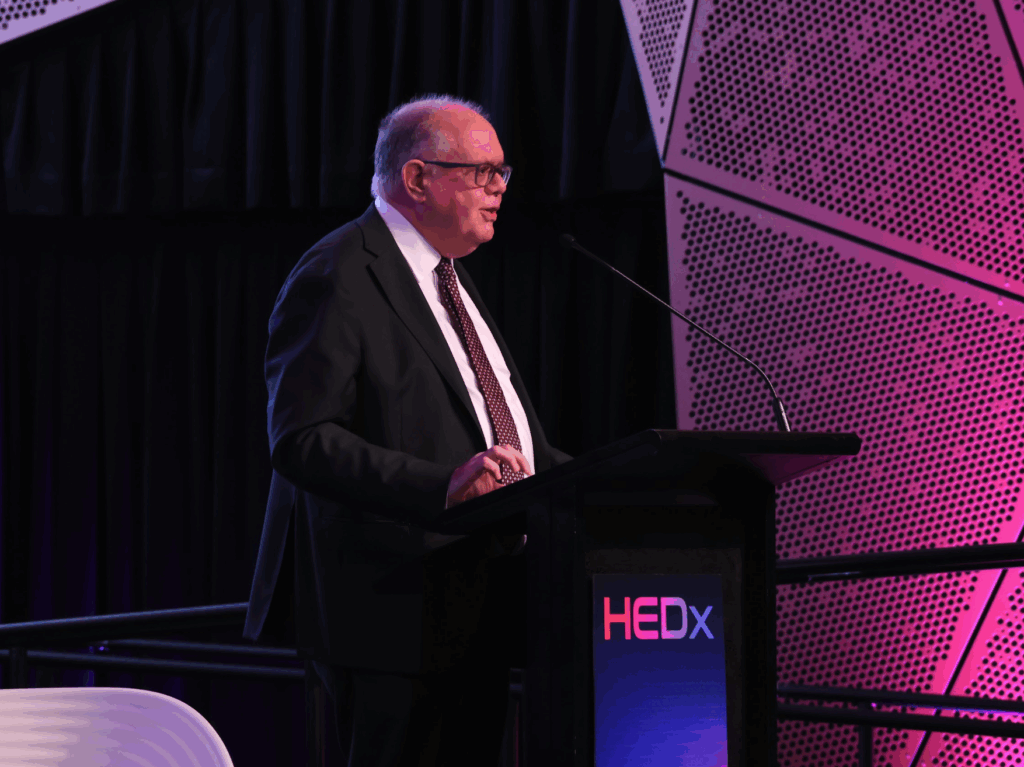
The HEDx conferences bring together educators, institutional leaders and innovators to explore ways to reshape higher education during rapid technological change. In his introduction at the UTS-hosted Disruption Through Connections event, HEDx founder Martin Betts infused it with a sense of urgency. Framed by an overarching theme of ‘connections’, the two days weren’t just about future possibilities, but about action: not what we might do next session or next year, but what we could do next week.
While AI and other technologies continue to accelerate, universities are falling behind. Global partnerships may offer strength in uncertainty, but are they resilient enough for the scale of disruption ahead? We explore these themes through key insights from panels and keynotes in Part 1 of our HEDx conference recap.
Connecting with AI and technology
Letting the future drive with Scott Pulsipher
Drawing on his experiences at Western Governors University (WGU), Scott Pulsipher argued that institutions must be designed with the future in mind rather than the current state, particularly during more frequent, impactful periods of transformation. To design models that are fit for purpose and meet emerging needs, institutions should start with a clear vision of the future and work backwards from there. The student-centred WGU model has led to higher completion rates, stronger employer satisfaction and significantly lower costs.
Scott argues that higher education must evolve further – towards personalised, lifelong learning pathways, mass-customised curricula and continuous upskilling – so that students can navigate a rapidly changing labour market. An education system that is accessible, relevant and designed to unlock the potential of every learner can also connect them directly to opportunity.
Disrupting the model from the inside with Pierpaolo Limone
Is it possible to disrupt a 900-year-old system? Pegaso University’s Pierpaolo Limone presented on leading the AI transition at scale in Italy. He noted that students have adopted AI prior to it becoming an institutional choice – the decision left to leadership is between governed and ungoverned use. Pegaso’s strategic plan is that the machine and the academic body shape each other; the integration of AI is neither substitution nor addition. Instead, AI is re-dividing academic labour so that the lecturer becomes a learning architect. This practice is supported by AI toolkits specifically tailored for students and staff, which were piloted and faculty-tested, and designed to move time from low-value tasks to teaching and learning.
The future university will be judged less by whom it keeps out, and more by what it makes people capable of becoming. The technology will not decide that. Leadership will. Pierpaolo Limone, Pegaso University
Online strategies for all students
A panel on Tuesday morning looked at how online learners are shaping pedagogy and strategy. Facilitated by Kylie Readman, it featured Jon Davey (OES), Siyan Ly (SinLearn), Dominique Parrish (Torrens) and Kayla Gates (UTS alumna – Master of Women’s and Children’s Health). The group explored broader ideas of who our students are now (often working, parenting, may be older, etc.), noting there should be no binary split between ‘online’ and ‘on campus’ students in the current environment. Online learning needs to be industry-focussed, student-centric, engaging and active, especially when we’re asking busy students to be present in sessions. To achieve this, we need to maintain and adapt our capabilities, curricula, schedules and technology and understand the diverse learning experiences of our students learning online.

Connecting with global partners
University alliances were discussed at a panel chaired by Martin Betts. A strong theme was the importance of ‘mission’ and how universities should anchor change in their purpose, whether it’s widening participation, serving communities or improving outcomes. Positive change can happen via partnerships with a balance of independence and collaboration: universities must take responsibility for their own sustainability and direction, while collaborating to learn faster, scale ideas and address shared challenges. Meaningful change also depends on action (not just conversation) and on creating supportive environments for staff to adapt.
On another partnerships-themed panel, Joe Chicharo, Paul Mazerolle, Welhong Liang and Shân Wareing shared examples of how challenges and multi-tiered engagement can make for transformational partnerships. Paul noted his attributes of strategic partnership: being purpose aligned, not just transactional, having trust, persisting and delivering enduring results. Shân added that it’s important to confront colonial legacy and why it’s there, as it can creates desires and tensions on both sides. How might we build a relationship free of an uncomfortable, problematic past?
Our wrap-up of the HEDx conference continues in Part 2; watch a video of the first day’s highlights below: