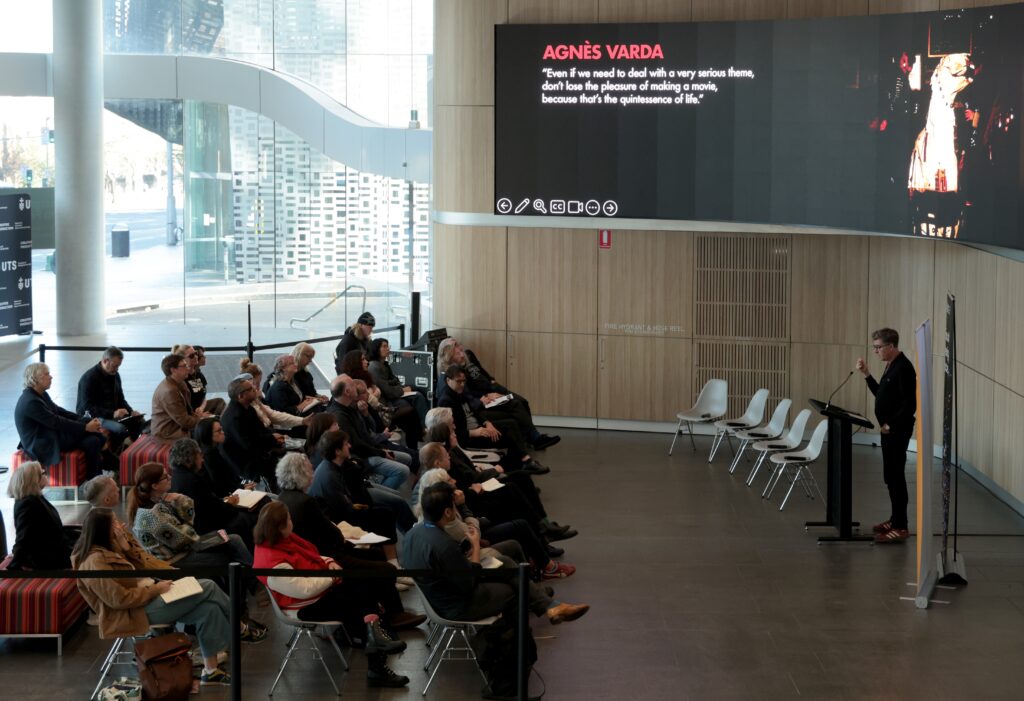
Even if we need to deal with a very serious theme, don’t lose the pleasure of making a movie, because that’s the quintessence of life. Agnès Varda, Film-maker
Despite ongoing discussion of the ‘death of cinema’ in our digital, online culture, last year’s Sydney Film Festival was the highest-selling festival in its history. I’m a dedicated attendee and one of the SFF films I gravitated to this year was Rose of Nevada by Cornish director Mark Jenkin. Its woozy time-slip narrative is contained within Jenkin’s Bolex 16mm camera, with post-synchronous sound adding to the discomforting atmosphere. His distinctive films also have a strong sense of place, with imagery like waves crashing over rubber boots and rattling ship cables capturing the visceral reality of the fishing industry in his home town of Cornwall.
Micro-budget filmmaking remains a vital entry point to the film industry, with many established filmmakers beginning their careers in this space. While Rose of Nevada (Jenkin’s third feature) isn’t strictly micro-budget, the director continues to use a constrained toolkit that shapes his distinctive style. The film’s executive producer Professor Neil Fox was in Sydney to discuss this mode of film-making at MicroWAVE 2026, a Faculty of Design and Society event organised by Associate Professor Alex Munt, Dr Gregory Ferris and Marcus Eckermann.
Student experience at the Sound Image Cinema Lab
Fox is also the research and strategy lead for Falmouth University’s Sound/Image Cinema Lab, a multifaceted teaching, research and film practice project that embeds industry collaboration in its pedagogy. The initiative emphasises experimentation over adherence to a single technology or production method, recognising that creative innovation emerges from exploratory environments. It also prioritises access and inclusion, particularly for working-class filmmakers and those outside traditional pathways, and focuses on local engagement so that films made within a community are also seen there.
Importantly, the lab rejects purely commercial objectives. Instead of financial return, it prioritises ‘pedagogic return’, valuing learning, experience and creative development. Neil Fox, the Sound Image Cinema Lab
In collaboration with filmmakers such as Mark Jenkin, Fox explained how this model could operate at scale without losing its core principles. Even as budgets increase, the emphasis remains on small crews, creative constraints and community-based production.
The lab offers an alternative vision for film education and production – one that centres creativity, community and ethical practice. It challenges the industry’s exploitative norms and encourages emerging filmmakers to imagine different ways of working.
Learning through failure in creative industries
Following his keynote, Neil joined a panel of representatives from UTS’s Faculty of Design and Society: Associate Professor Mohammed Makki (Architecture), Dr Cecilia Heffer (Fashion) and Diamond Tat (Screen). During the panel, they addressed the tension between institutional structures and creative industries, the role of creative practice as research, and the importance of interdisciplinary collaboration.
A central theme was the ‘messiness’ of making as a valuable form of knowledge. Panel chair Gregory Ferris asked the panel how educators can help students navigate the uncertainty, failures and evolving professional contexts of these professions.
To become a successful architect, you need to understand the value of failure. You need to understand that if you fail, that’s part of the process. Associate Professor Mohammed Makki (Architecture)
The group highlighted that students may arrive with rigid expectations shaped by school systems that prioritise perfection and measurable success, whereas failure is an essential part of creative practice. Students initially seeking perfect outcomes can gradually learn that growth comes from experimentation and mistakes. Over time, many shift from focusing on grades to valuing the learning process itself. Teaching strategies to help students on this journey include sharing your own failures, framing projects as exploratory, and encouraging students to reflect on both success and shortcomings.
At question time, a Macquarie University academic asked how education can remain relevant in a rapidly changing world shaped by technological advances, including AI. Rather than focusing solely on current industry demands, the panel emphasised developing adaptable skills such as critical thinking, visual literacy, communication and the ability to learn continuously. While tools and industries evolve, the fundamental value of creative practice – making, reflecting, and connecting with others – remains constant.
Don’t lose the pleasure
In a Sight & Sound interview, Jenkin suggested he would rather go back to his student job of working on the bins than make a digital studio film as a director for hire. This takes us back to the quote from one of his admired directors, the great Agnès Varda: don’t lose the pleasure of what you’re doing creatively.
The presentations and discussions at MicroWAVE emphasised this point. While there will aways be institutional demands, industry realities and rapid technological change, supporting students to stay true to their roots and creative impulses – and having the freedom to make mistakes – will set them up for success in the creative industries.
Images by Marcus Eckermann. Feature image: (L-R) Gregory Ferris, Mohammed Makki, Cecilia Heffer, Diamond Tat, Neil Fox; Below: Neil Fox delivering his keynote