For its second year of partnership, the Transdisciplinary School and Miro centred in on this challenge: how might a new generation of workers change the ways of working of collaborators, communities or organisations to foster innovation?
The Transdisciplinary Action Lab, part of the Transdisciplinary Electives Program, united over 500 students from more than 100 disciplines to unpack the complexity of the modern world and learn how to meaningfully intervene when problems arise.
Miro staff were involved throughout the subject, contributing video assets, joining live Q&As and briefing sessions, as well as judging the final student showcase. For students, that means working on a real project co-designed with industry professionals that they can refer to on their resume or portfolio, or even in a future job interview.
The showcase
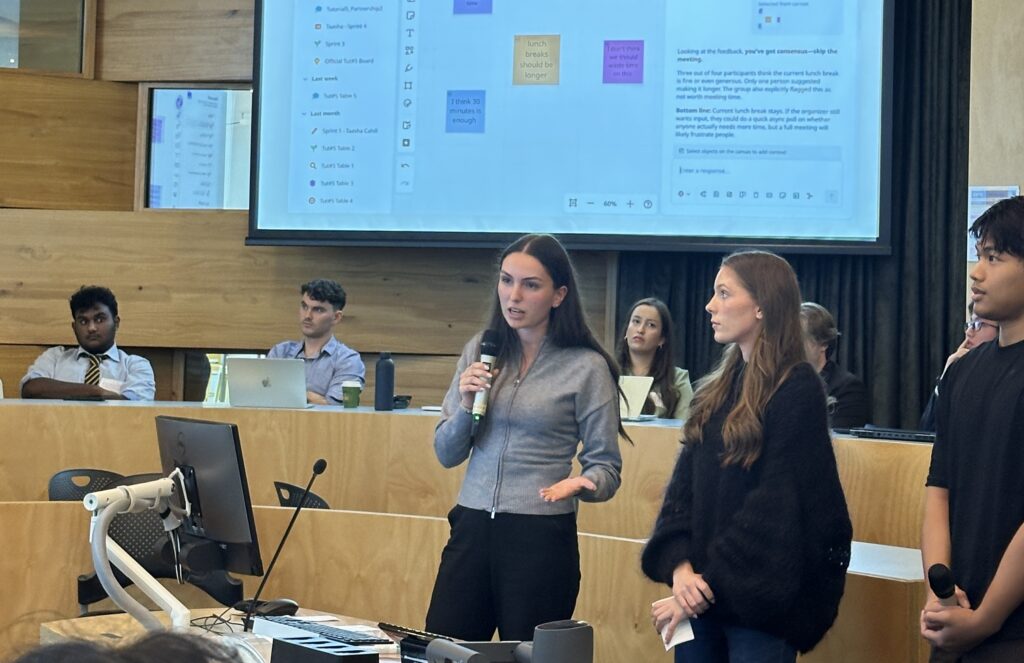
In mid-May, 5 student teams pitched their responses to Miro staff involved in the subject. The ideas were wildly different: a VR career exploration platform; a live radio-show performance with Beyoncé, Pope Francis, Da Vinci and Einstein “phoning in” to discuss biomimicry-inspired collaboration; a new Miro AI tool that decides when meetings can be skipped because consensus has already been reached. What they all had in common was a shared process of collaborating and problem-solving together on a single canvas, with the guidance and support of Miro technical experts.
For Miro, this is the kind of practice they hope students will carry into industry:
We are excited to partner with universities, and especially UTS, to work in a program where students collaborate on Miro and learn how to work in a collaborative, cross-disciplinary and inclusive environment. Bringing that practice into the workplace once they graduate from university will be invaluable. Andrey Khusid, CEO Miro
Students described the cross-disciplinary mix mattered just as much as the Miro platform:
Having spent the last four years of my degree working with only tech students, this was an amazing experience to see different perspectives and ways of thinking that I would’ve never considered. Joan-Paula Conducto, Bachelor of Information Technology
Key takeaways
A few things stood out for the teaching team. The first was how much having everything on a shared canvas changed the way tutors gave feedback. Tutors could now step in earlier and be more specific with support and guidance, rather than waiting to respond to a finished piece of work.
The second was unexpected. When Canvas went offline due to a global security breach, impacts were minimal because the work lived in Miro. Building a subject around the tools students will use after they graduate turned out to have a practical upside that no one had planned for.
The third was about how students showed their thinking. Moving to visible brainstorming, presentation and reflection videos brought out ideas that a written submission might not have captured – which is especially useful in the age of AI.
Curious about Miro in your own classroom?
Bringing Miro into your own classroom doesn’t have to be a big undertaking. Plenty of teaching teams start small with just a single shared board for a tutorial activity, or a team board to help tutors coordinate behind the scenes.
If you already run a brainstorm, a group planning task or a feedback activity, the easiest first step is simply to move it onto a shared board and see how students respond. What worked for the TDS team wasn’t a new way of teaching; it was taking what they already did and making it visible enough for everyone to work on together.
The Miro Hub (UTS staff log-in required) is a great place to start your upskilling journey. Here you’ll find real use cases, tutorials and tips for bringing visual collaboration into your teaching.