
The rise of Generative AI has left many students and teachers asking the same questions: How do we use this technology without losing the ‘learning’ part of education? How can we use AI more thoughtfully to support the learning process, not just more polished outputs?
Many are already moving away from viewing AI as an ‘answer machine’ and seeing it more as a sparring partner. Some thoughtful examples of how we can guide and support learners were shared in a recent webinar featuring Kelly Webb-Davies from the University of Oxford’s AI Competency Centre, including a framework to consider how actively engaged learners are with different activities, and some personas to bring to life the role AI plays for us.
How much are you actually learning when you use AI?
You’re trying to change your brain, but to change your brain, you need to do the intellectual work yourself. You don’t want the AI to do that, but the AI can help you as long as you’re using it and approaching it the right way.
Kelly Webb-Davies, University of Oxford AI Competency Centre
Kelly tackled this question head-on in a recent webinar: Training the Brain, Not the Bot. In this 15-minute session, Kelly introduced the ICAP framework (2014) as a way of thinking about how learners engage with AI in terms of cognitive engagement.
The framework can be visualised in different ways, but the graphic used in this case indicates increasing levels of engagement, from passive ‘consumption’ of content, through to interactive co-construction and understanding through dialogue.
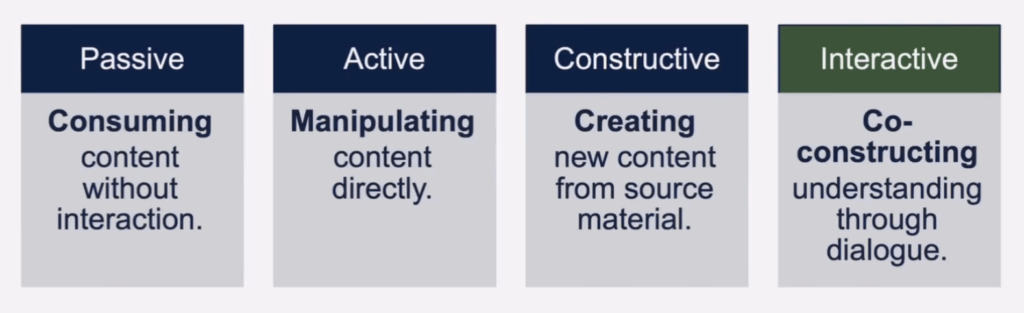
ICAP can support learners and educators to consider how much learning is likely to be taking place when you use AI in different ways. For example:
- Passive & Active (Low Impact): If you simply ask AI for a topic idea and accept it as is (Passive), or just pick from a list of its suggestions (Active), you are not cognitively engaged.
- Constructive & Interactive (High Impact): This involves you doing the initial ‘heavy lifting’, then using AI for feedback – drafting drafting your own mind map of themes and ideas, for example, or engaging in a back-and-forth dialogue where you justify your choices while the AI pushes back.
So how does this look in practice, and how might it be used to improve learning?
Engaging your brain with AI: reading, drafting, and brainstorming
Think of it as a way to get information from you, or from a verifiable source. Instead of asking it questions, get the AI to ask you questions, so your brain is doing the work.
Kelly Webb-Davies
Ever asked AI to ‘summarise this article’? Skipping readings, particularly long or difficult ones, has tempted many a learner to reach for an AI support buddy too. Here’s how the ICAP framework can offer alternatives that keep the brain increasingly engaged:
- Passive: Ask AI to summarise the reading
- Active: Ask AI to extract headings, key terms, and a glossary from the reading
- Constructive: You read, then write your own summary and ask AI to flag issues like omissions or unclear claims
- Interactive: You read, then ask AI to quiz your interpretation; you defend and/or revise based on feedback
Drafting written work is another common activity where AI can be asked to join the learning process too early, or is not offering enough challenge. In this case, the ICAP framework might suggest:
- Passive: AI writes your draft; you accept and use it
- Active: AI writes your draft; you re-structure it
- Constructive: You write the draft and ask AI for feedback on clarity, logic, and evidence; you re-write and ask AI to evaluate the improvement
- Interactive: Iterative review dialogue: you justify each change; AI counters, asks for reasons, abd pushes for stronger support
A third example shared by Kelly was brainstorming. In this case, the goal is to keep the ‘ideation engine’ in your own head:
- Passive: ask AI for a topic idea and accept it
- Active: ask AI for a number of suggestions and use your judgement to choose the best
- Constructive: draft your own mind map or outline; ask AI to critique and suggest missing topics
- Interactive: upload your brainstorming to AI and prompt it to ask you questions, guiding you to think deeper for more ideas.
Is AI a stranger in the pub, a helpful intern, or something else…?
In addition to the ICAP framework, Kelly also suggests exploring different AI ‘personas’ when using tools like ChatGPT, CoPilot and Claude. The personas can help learners think about the different roles that AI tools can play in your learning, which may shift depending on the task at hand. The five AI personas are:
- The STRANGER – good for brainstorming ideas, but not a reliable or citable source (like a stranger you might chat to in the pub!)
- The INTERN – helps with tasks, but you must check and correct it (they make mistakes, so your expertise is still important)
- The TUTOR – supports your learning without giving you answers (try asking questions like you would with a new human tutor, e.g. be specific about your subject, level, and learning goals)
- The TRANSLATOR – helps clarify and improve your expression (but the core ideas and arguments must be your own)
- The PEOPLE PLEASER – tends to agree with you, so you must actively seek critique (don’t let AI flatter you into complacency!)
To support this process further, the Oxford AI Personas GPT was created for learners to interact directly with the personas, encouraging discussion about responsible use of generative AI through the use of generative AI. You ask it to recommend a persona for a learning task you have if mind, or learn more about each of the personas and what they’re helpful for.
You can also read more about each of the personas in the AI persona guide. Kelly points out that all the personas should be considered – you can’t just choose a persona and assume it will explain everything about how generative AI tools work for you.
Let’s keep the chat window open…
Frameworks like ICAP and the AI personas are helping to spark more honest, practical conversations with students and educators about what learning can look like in partnership with AI. If you’re not already chatting to your students about how they’re using AI to support their learning, it’s not too late to start.
In your own teaching, you could choose to share an AI persona that resonates (or frustrates!), or ask your students where on the ICAP spectrum they think their last AI interaction landed – they might be surprised by what they see. If we can keep the chat window open and model the kind of critical thinking we want to see, we can support learners to make more active and conscious choices about their interactions with AI – and make sure the brain is doing the work, too.