Co-written by Chris Girdler and Lucy Blakemore
When it comes to Generative AI, a lot can happen in a year. The Faculty of Health GenAI-ENHANCE Summit launched last year, delivered as an engagement piece from a Faculty of Health Teaching and Learning Scholarship led by Dr Lucy Bryant. In the 12 months since, there was so much to discuss on various levels, reflected in an impactful day of rich, diverse perspectives. The tone and themes of the presentations have levelled up, with a shift in focus from developing AI literacy and discovering new tools, to deeper co-design processes, iterative development of simulations and an eye to the future to better understand how we might use GenAI well in the present.
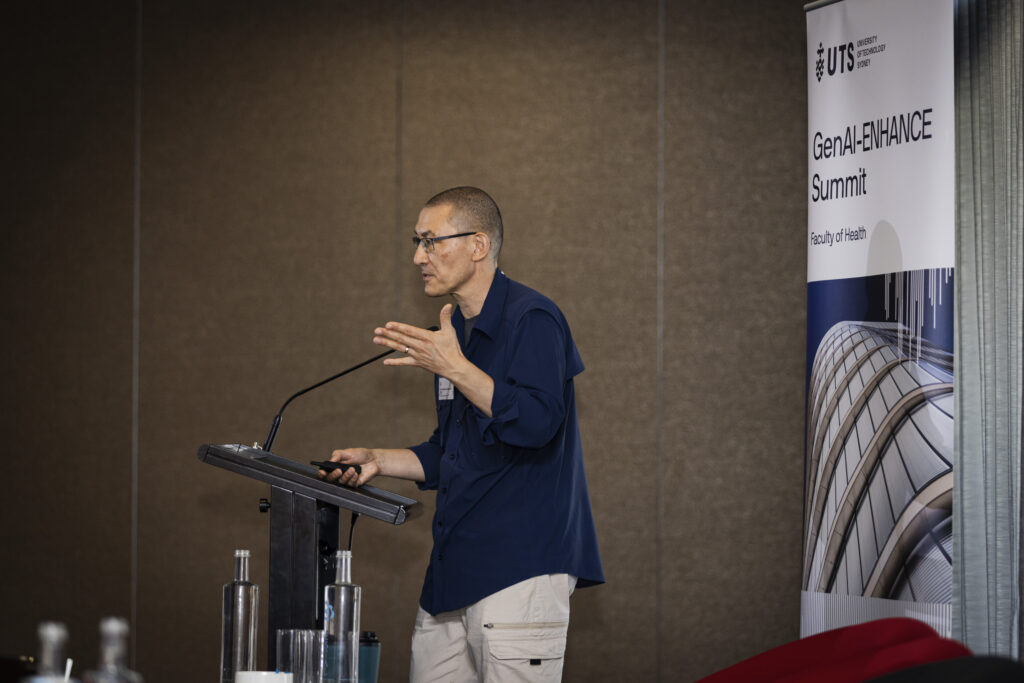
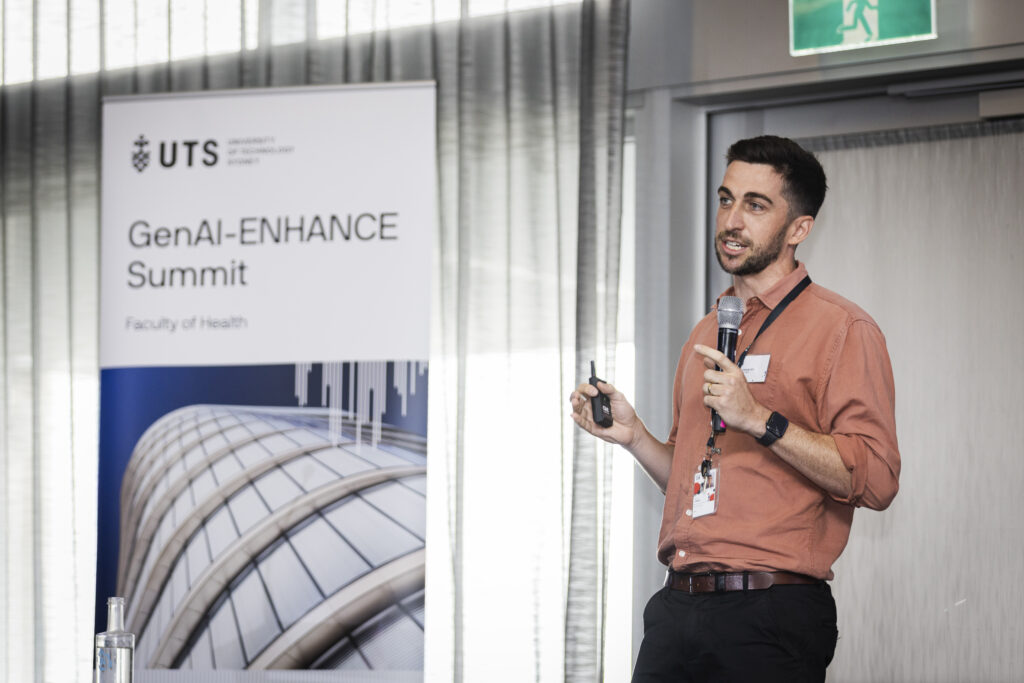
In his keynote, Simon Buckingham-Shum explored the concept of conversational AI as thinking partners in the age of polycrisis, which he described as an entanglement of crises that all have implications for health and social support systems. He shared examples of learning through dialogue beyond ‘sycophantic chatbots’, which may help us and students engage with complex arguments beyond our usual boundaries. Tools like the Qreframer prompt can help us surface assumptions, for example, whilst others like Augmented Collective Intelligence focus on problem-solving capabilities with AI. These ‘thinking partners’ help us equip students (and ourselves) with different sense-making approaches for this complex environment.
The importance of co-design
Co-design is an approach to designing with, not for. In the case of GenAI, creating space and allowing time for focus groups, interviews and surveys makes it easier to get it right for all stakeholders, not just leaders and designers. This was evidenced in Julia Dray‘s exploration into how AI might assist in alleviating struggling health support systems. Integrating trustworthy AI into client-facing allied healthcare practice is a challenging proposition, and mapping processes articulated by both families and practitioners only adds to what Dray described as ‘messy’. However, it’s only when these variables are designed to reflect real people that we can start to authentically find a way forward.
An FFYE grant on GenAI chatbot simulations in the Bachelor of Nursing overcame some challenges (testing tech, real-time responses, assessment security) to deliver transferable outcomes for other disciplines. Tran Dinh-Le explained how, by interacting with a virtual patient, students can develop therapeutic communication skills in a safe environment and gather necessary information for clinical decisions. The co-design approach was crucial to its success, with a family of bots evolving as each stage of student feedback was applied.
Simulating clinical engagement
Delivering on her T&L Scholarship, Lucy Bryant reported on 3 projects drawing on AR and VR enhancements for research and teaching, particularly in anatomy and clinical exams. Each study provided insight into different technologies, using ‘autoethnography’ on the experience of using the Apple Vision Pro, for example, and co-design of learning experiences using Mega Quest 3. Testing of one bespoke laptop-based SIM clinical prototype underlined the importance of user testing and the critical need for real-time responsiveness.
Dani Gardner explained how she incorporates AI conversation agents in healthcare curriculum using SimConverse (a platform represented on the day by co-founder Aiden Roberts). These simulations run across multiple contexts and study cohorts, including outpatient clinical review (getting ready for placement), mental health, critical care and diabetes education/management.
Surfacing the invisible
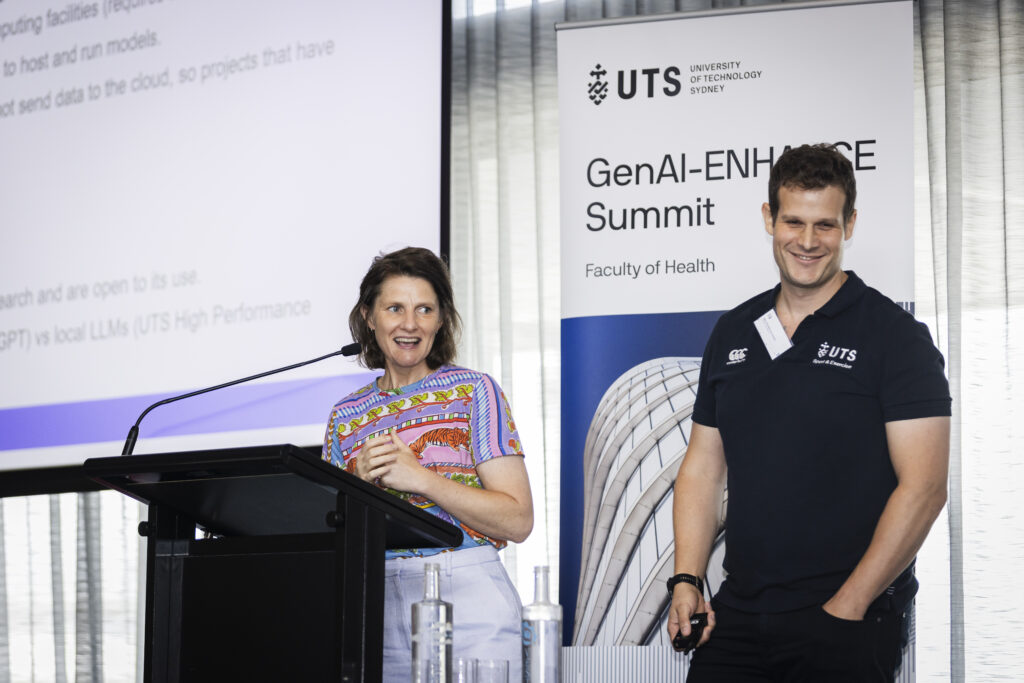
There is seemingly no limit to the data-tracking gadgets available to monitor fitness, but deeper insight can also be gleaned from the qualitative conversations between coaches and athletes during training. School of Sport, Exercise and Rehabilitation reps Katie Slattery and Steven Hughes explained that whilst AI can assist with capturing and analysing audio data for athlete monitoring, the issues here tend to focus on ethics and privacy. Do coaches and athletes feel comfortable being recorded? And how can we ensure data is only housed internally and not shared more broadly?
Dying for a meal research shows increasing rates of choking-related deaths which could have been prevented. Fiona Given and Bronwyn Hemsley used GenAI as a quick-acting data extraction with a narrative analysis, which revealed high-risk locations that were low on supervision, documentation or support. The next steps are to act on these findings, including a call for cohesive responses across aged care and disability services, changes in policy and a focus on behaviour support.
A new dawn for health?
People are increasingly turning to GenAI chatbots for health advice. As a health professional, are you ready to be the second opinion?
Dr Joshua Pate, Senior Lecturer in Physiotherapy
What many consider future concerns about AI usage are already realities in the present. How many of us are asking chatbots about our own health symptoms even before we get in touch with a qualified health professional? Joshua Pate questioned whether AI could be helpful or harmful if it validates current stereotypes or stigma, or challenges credibility, though it is becoming more nuanced.
Emma Power reflected on the past (2022), took stock of the present (2026) and looked ahead to the future (2030) in a time-travelling journey through parallel lenses of learning and teaching, HDR/research and clinical practice. It was fascinating to reflect on what pre-adoption and incremental application looked like, and consider potential futures where AI may become routine (or not). Emma posed some challenging questions about how the use of AI in society might impact on her subjects, and invited us all to reflect on whether it heralds the sunset of our teaching careers or a new dawn.
There’s no crystal ball to inform exactly how we need to prepare ourselves, our subjects and our students for the future. Further progress is being made this year with support from the Education Portfolio via a staggered curriculum transformation project and broader guidance from TEQSA.
The GenAI-ENHANCE Summit offers the Faculty of Health a platform to share ideas and inspire confidence to make bold steps into the future with GenAI. Who knows what brave new world we’ll be in this time next year?
Thanks to Bronwyn Hemsley and Jessica Durant who convened the Summit with assistance from Lucy Bryant, Julia Dray, and Louisa Wilson.