
Co-authored by Mike Engelsman and Jeremy Chu.
This project was funded by the Students as Partners Project Grants program.
Hands-on learning is an integral part of many engineering degrees, and is crucial for students to experiment, learn, and innovate. However, access to lab and workshop spaces within the Faculty of Engineering and IT (FEIT) at UTS comes with a set of challenges.
Our Students as Partners (SaP) research project set out to explore the potential need for a dedicated Maker Space at UTS. During our research we uncovered numerous issues with the existing labs and workshops around access, visibility and functionality.
We decided to shift our focus, and with the help of our staff partner Marc Carmichael and mentor Sam Fergusson, set out to understand the current issues and develop recommendations for improvement.
Why is this important
There are a range of world class laboratory and workshop spaces available to FEIT students at UTS. The visibility and ease-of-access to these spaces impacts their use by students in hands-on learning.
Currently, there is a significant lack of understanding amongst engineering students around which spaces can be used, which equipment and materials are available, and how these can be accessed. Information on the use of these spaces is hard to find and sometimes even harder to understand. This leads to students completing project work such as machining, mechanical assembly, and live circuit testing in an unsupervised and uncontrolled environment.
Our study aims to understand the exact issues students experience regarding the lab and workshop spaces and develop solutions in collaboration with students to improve that experience.
Our findings
The survey we sent out to engineering students attracted over 500 responses across all FEIT majors. These were filtered for relevance and 273 responses were analysed for our research. The findings can be broken down into several overarching themes.
- Awareness: Almost 20% of the respondents are unaware lab and workshop spaces even exist.
- Usage: Over 60% of the respondents don’t use these spaces outside of scheduled classes.
- Safety: 113 respondents reported undertaking over 330 unsupervised off-campus activities such as soldering, machining, assembly, and welding.
This data indicates that there is a distinct information gap around the availability and usage of these spaces and how they can be utilised. Additionally, the off-campus activities create a serious safety risk to students working on projects.
The student experience
Students indicated that the most common issues with lab and workshop spaces are the following:
Restricted opening hours
Students who balance study with work or family commitments highlighted that current access hours are especially restrictive, with several expressing the need for extended or flexible access. One participant commented, “We need open hours in the evenings and weekends. That’s when most students can actually work.” The lack of flexibility has led many students to complete projects at home, which undermines the purpose of these spaces. As another student explained, “I end up doing projects at home, buying my own tools and sourcing materials because I can’t get access when I need it.”
Booking and administration
Respondents feel there is a need for a central online booking portal similar to systems used by other faculties with one noting that “A centralised website that lists labs, open times, and booking methods would solve half the problem.” Others highlighted that while structured systems can promote fairness, they must be user-friendly and well communicated, explaining that “A booking model is the most equitable, but it leaves students stranded if they don’t know how it works.”
Communication and awareness
A major barrier to effective lab use is poor communication about access rights, procedures, and available facilities. Many students admitted they were unaware that they could use labs outside of class time, or even that such spaces existed with one student noting, “I didn’t even know we had labs I could use until my final year.”. Others described the process of gaining access as confusing, with comments such as “Make the procedures to access labs visible in a public place. I had no idea where to start.”
Recommendations and next steps
In response to these findings, we propose the following recommendations to guide feasible and impactful improvements to lab and workshop access and utilisation within FEIT:
- Extend and optimise access hours
FEIT could pilot extended access periods such as evening or weekend sessions for selected high-demand spaces. - Centralise lab and workshop space information and availability
Develop a centralised digital resource or portal that lists all available spaces, their locations, equipment, inductions, booking procedures, and availability. - Simplify the booking and approval process
Review and streamline the current booking systems to reduce administrative barriers. A central booking platform that can be accessed via the proposed platform in point 2 or be integration with existing student systems. - Introduce structured after-hours supervision
Establish a framework for supervised after-hours access, potentially through trained student volunteers, technical staff rotations, or postgraduate students. This approach would enable greater flexibility while maintaining safety standards. - Integrate lab and workshop space orientation into the student experience
Embed lab and workshop space awareness and training modules within first-year engineering subjects or orientation programs. These can sit next to mandatory training modules such as Consent Matters.
By adopting these recommendations, UTS and FEIT can significantly improve the ease of access, safety, and educational value of its labs and workshops. An incremental and evidence-based implementation will allow the faculty and individual schools to enhance the student learning experience, support equitable access, and align operations with UTS’s strategic goals for student engagement and innovation.
If any UTS staff member would like to review the report, please request access from the staff partner, Marc Carmichael, at Marc.Carmichael@uts.edu.au. For questions about the program, please email sapprojects@uts.edu.au.
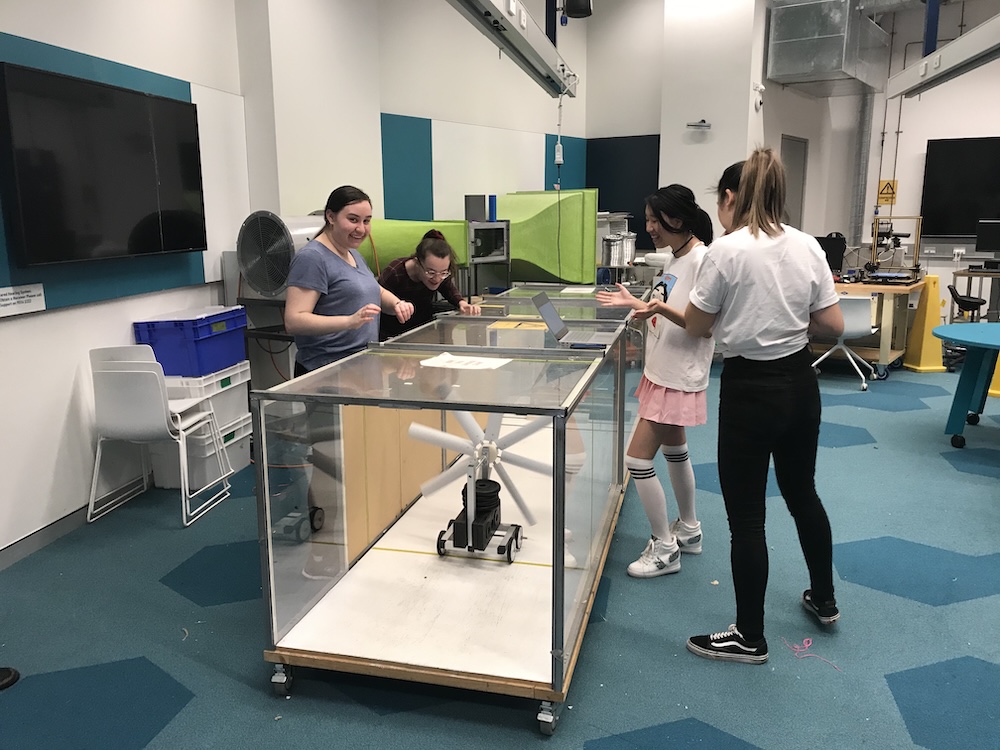
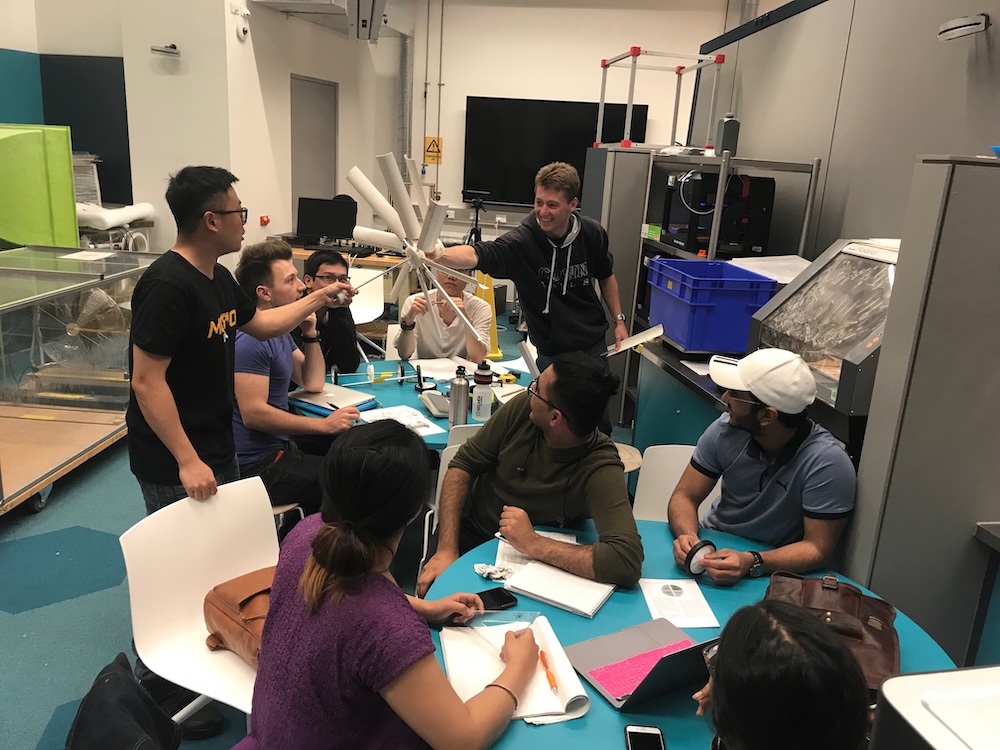
Thank you to Terry Brown for providing images taken of first year mechanical engineering students planning, developing, and testing their designs of wind powered vehicles in the Mechanical Design Studio (CB11.B4.109).