
Have you ever wanted to scrutinise why social justice matters in university education? Many people in academia can point out exclusionary practices, and unnecessary bureaucratic barriers that disadvantage students or staff. Yet fewer understand what is required to support staff to enact an inclusive practice that leads to positive change.
Practising Inclusion for real impact
Practising Inclusion: Working and Teaching for Social Justice is an interactive, online subject that runs over six weeks. It introduces you to the fundamentals of equity, human rights and social justice and their role in actively shaping a more inclusive higher education space.
Peer‑reviewed research shows that this subject’s participants develop a stronger understanding of equity and social justice, along with the confidence and agency to act. Graduates will apply their learning directly by redesigning assessments, embedding Indigenous perspectives, and making teaching and workplace practices more inclusive. The subject equips staff with the practical skills, critical insight and permission to lead change, creating more inclusive and equitable learning environments across higher education.
Course information
This course is suitable for anyone with an interest in inclusive practice in higher education, including:
- academics and university professional staff
- equity practitioners
- PhD students and postdoctoral fellows who teach UTS students
During the course, you will learn to:
- explore the concept of inclusion and exclusion in higher education
- understand the experiences of historically marginalised groups and their intersectionality
- consider how culture, diversity and identity impact on learning and social interaction
- examine the principles for inclusion and adapt them to own professional context
- grow your tool-belt for inclusion and social justice
- create conditions for change that produce more just, inclusive and equitable spaces
- take action in your own work and life
With 6 modules, 4 synchronous sessions and 2 assessment tasks that relate to your personal life and professional practice, there’s plenty of online interaction. The synchronous sessions take place in March and April on the following days and times:
- Week 1: Tuesday 3 March, 10am–11.30am
- Week 2: Tuesday 10 March, 10am–11.30am
- Week 4: Tuesday 24 March, 10am–11.30am
- Week 6: Tuesday 7 April, 10am–11.30am
Engage in critical pedagogy
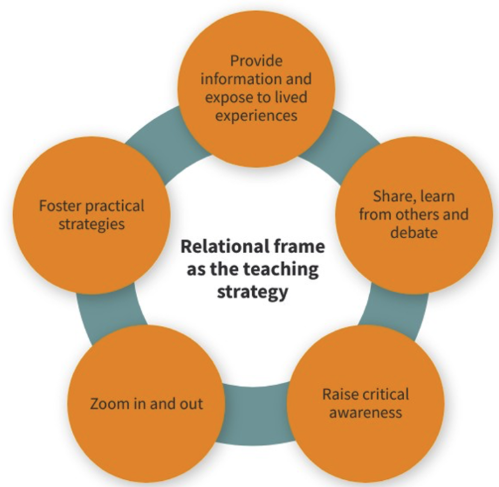
The teaching approach of this course is underpinned by critical pedagogy following Paulo Freire. It includes two dimensions: awareness raising and action for change. With a choose your own adventure approach, Modules 1-3 focus more on awareness raising; Modules 4-6 emphasise actions for change. The 5 teaching strategies that underpin this course are listed in the diagram below. These strategies are all interdependent and form a relational frame.
Graduates from this short course have said:
There were so many little things that I think overall have given me confidence to advocate in stronger ways or pursue actions that I think will make a difference, or bring certain issues to attention
It’s about empowering us. And we’re being empowered by being able to just look, be aware that there are other ways of doing things, other options and so it’s that empowerment through learning.
The assignments acted as a really good trigger to act.
I stole a few ideas how to design accessible content in the online learning environment.
The Indigenous content gave me a much deeper appreciation of nuances.
How to enrol
Here’s how you can join us in 2026:
- Current UTS academic or professional staff – apply as a UTS student for a non-award subject (it’s free for UTS staff)
- GCHETL students – enrol in the elective subject Practising Inclusion
The deadline to enrol is February 16, 2026. For more information, please contact the subject coordinator, Professor Franziska Trede.