
In my first-year accounting subject at UTS College, one of my favourite assessments has always been the weekly quiz. These quizzes were designed to help students recall foundational concepts, an essential part of building long-term memory (Weinstein et al, 2018).
So what happens when students ace the weekly quiz but fail their final exams? This was happening last year with my students and forced me to rethink my assessments, and the role they play in building awareness of learning.
When GenAI inflation hits your quiz scores
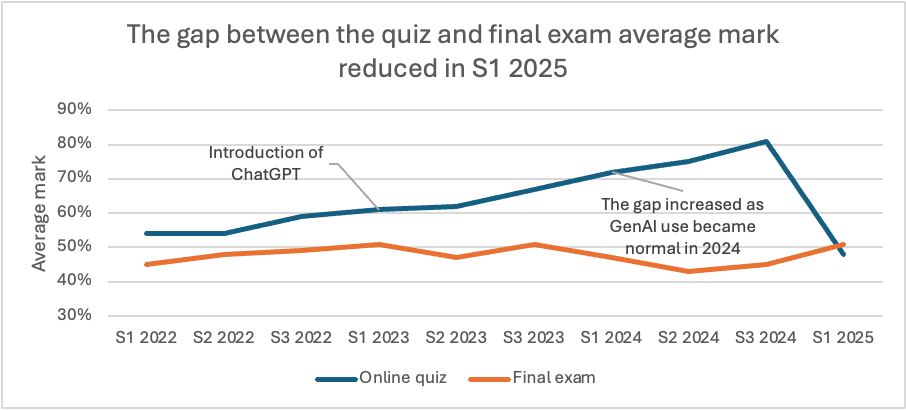
Between 2022 and 2024, average quiz scores in my subject jumped from 54% to 81%. These quizzes were untimed, unsupervised, and completed outside class – perfect conditions for students to get help from GenAI. But while students scored well on quizzes, they struggled in class and underperformed in final exams. Many overestimated their understanding, mistaking easy access to answers for actual learning.
A Chegg Global Student Survey (2025) found 80% of students worldwide use GenAI, with 55% saying it helps them learn faster.
Lots of students believe GenAI helps them learn, and they’re increasingly open about it. When I surveyed my own students, I found that 75% of new students in my class agreed that GenAI improves their learning. Recognising that students will use these tools, we embrace an educational approach and aim to support their effective use for learning. But as Jason Lodge points out, GenAI is built for productivity, not deep learning. Real learning is slow and effortful; GenAI’s convenience may hinder meaningful learning.
In 2025, I made a change. Quizzes were done in the classroom, and access to GenAI was restricted with LockDown Browser software. Whilst classroom time is precious, I felt that using this time to do the quizzes was worthwhile; the action research project I ran to gauge the impact of this had important learnings for both me and the students.
Shocking scores, early warnings and practical prep
I would love to say that students got great quiz marks, but they didn’t. The quiz results were poor, and much lower than in 2024. Students were shocked. They had underestimated the time needed to learn the basics.
However, these poor results started important conversations about learning. Students were coming to me to talk about their progress, rather than me chasing them. We talked about ‘overlearning’ the basics and how to do this (lots of practice). The early, low stakes poor results gave students an early warning and a practical lesson on being prepared (i.e. it’s good to bring your notes and a calculator to an accounting quiz!).
While the quiz results weren’t good, I was relieved to see that the final exam responses were so much better, compared to 2024. This suggests that those tough in-class quizzes eventually encouraged deeper learning and better preparation from the students. For the first time, the final exam average mark was actually higher than the quiz average mark.
Learning the ‘work of learning’
AI tools can still be used effectively for parts of the learning process; they can be ‘tutors’ for students to ask endless questions, helping to clarify new concepts, or spark ideas when tackling difficult problems. However, many time-pressured students tend to use GenAI as a shortcut, which ultimately short-cuts their own learning.
By the end of the semester, I realised this was not about GenAI, it was about learning; learning as a slow, intentional process of saving new knowledge in long-term memory. My assessments need to help students build their foundational accounting knowledge and lifelong learning skills, developing automatic recall of key concepts so they can build on them and apply them to business problems. I don’t know about you, but I don’t want future accountants spending 30 minutes deciding whether something is a debit or a credit (AERO Explainer: Mastery and application).
As we begin a new semester at the College I’m ready to keep learning along with my new cohort of students, feeling better prepared to guide them in what to expect, and how to prepare for it. Let’s see how the learning goes for both of us!
Note: LockDown Browser software is currently unavailable at UTS but is currently being investigated as a potential addition to our digital learning ecosystem